
Key points
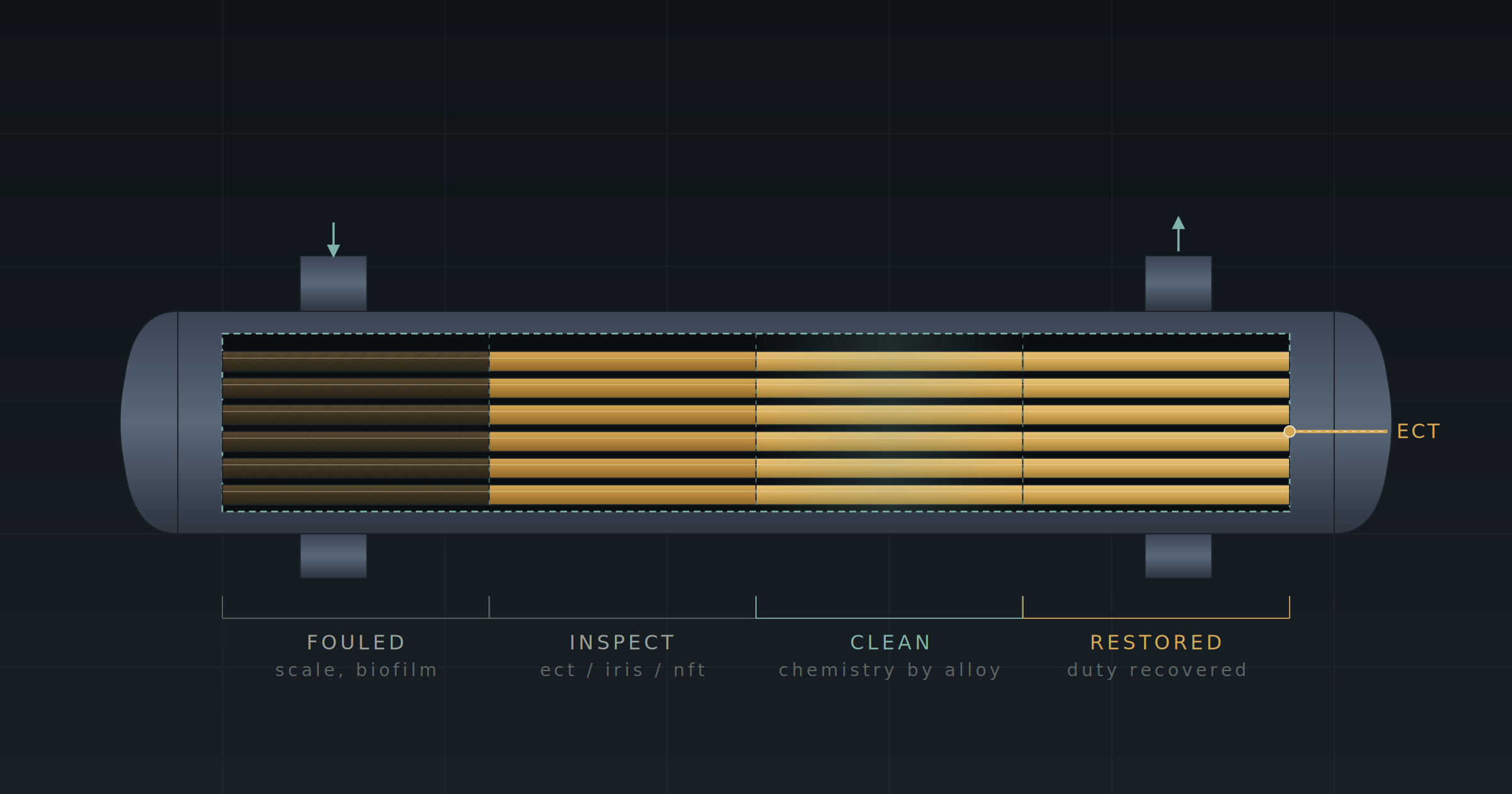
Heat exchanger maintenance is the difference between a unit that meets its design duty for 20 plus years and one that loses 15 to 30 percent of its capacity within a few cycles. The work breaks down into four disciplines: monitor performance against baseline, inspect for material degradation, clean to restore heat transfer, and decide when to repair versus retube. The right plan is matched to the service, the construction type, and the tube alloy. Generic plans tend to under-clean, over-clean, or use chemistries that strip the protective films from copper alloys.
A heat exchanger does not fail loudly; it degrades. Fouling deposits an insulating layer on the heat transfer surface. Corrosion thins tube walls one micron at a time. Vibration loosens baffle supports. Each is invisible until the unit can no longer hold its outlet temperature, until a tube ruptures, or until the energy bill quietly climbs because the upstream system is compensating for lost duty.
Tube failure is one of the most common causes of heat exchanger downtime. The mechanisms are well documented in TEMA, AMPP, and Copper Development Association literature, and they are entirely manageable with a maintenance program that matches the threats in the actual service.
How heat exchangers lose performance
Fouling is the largest contributor. Six types are recognized: particulate (suspended solids), crystallization or scaling (mineral precipitation), biological (bacterial, algal, macrofouling), chemical reaction (polymerization or coking), corrosion fouling (the surface oxidizing on itself), and freezing. Real units usually show more than one type at once, and each responds to a different cleaning method.
Corrosion attacks the tube material directly. The mechanisms that matter most for heat exchanger tubes are uniform thinning, pitting, dezincification (in uninhibited brasses), stress corrosion cracking, galvanic attack, and erosion corrosion at high velocities. Each tube alloy has its own envelope, which is why maintenance has to start from the alloy.
Mechanical degradation includes baffle damage cuts from tube vibration, gasket creep, and tube-to-tubesheet joint loosening from thermal cycling.
Performance monitoring
A program built on calendar intervals will either over-maintain a clean unit or arrive too late at a fouled one. The better foundation is monitoring against the unit’s own baseline.
The four indicators that matter:
-
Overall heat transfer coefficient (U) trending downward is the clearest fouling signal.
-
Approach temperature widens as fouling accumulates.
-
Pressure drop rising on the tube side suggests internal deposits or partial blockage; on the shell side, external fouling or vibration damage.
-
Control valve and pump speed drift is a leading indicator that the system is compensating for lost duty.
A common operational heuristic is to trigger cleaning at 10 to 15 percent U-value loss from baseline, but the right number depends on the cost of cleaning, the cost of lost duty, and the rate of degradation in the specific service.
Note: This range is a heuristic, not a standard. Validate against your own data.
Need a reliable heat exchanger tubes solution for your project?
Contact our team to discuss your requirements and get expert support on material selection, specifications, and manufacturing options.
Inspection methods
Performance monitoring tells you the unit is losing duty. Inspection tells you why.
Visual checks at every shutdown opportunity catch surface degradation, gasket condition, and signs of leakage. Pressure testing per ASME Section VIII verifies tube integrity at a multiple of operating pressure.
For shell and tube bundles, non-destructive testing is where the actionable data comes from:
-
Eddy current testing (ECT) for non-ferromagnetic tubes (Cu-Ni, admiralty brass, aluminum brass, austenitic stainless, titanium). Fast full-bundle screening for pitting, wall loss, and baffle damage.
-
Remote field testing (RFT) for ferromagnetic tubes (carbon steel, ferritic stainless).
-
Internal rotating inspection system (IRIS), ultrasonic, for high-resolution wall thickness mapping. Used to confirm and quantify what ECT or RFT flags.
-
Near-field testing (NFT) for finned tube bundles, where standard ECT is distorted by the fin geometry.
A typical campaign uses ECT or RFT for full-bundle screening, then IRIS to confirm wall thickness on flagged tubes.
Cleaning methods
The right method depends on the fouling type, the construction (whether the bundle pulls), and the tube alloy.
Mechanical cleaning (hydroblasting, brushing, drilling, lance cleaning) physically removes deposits. Effective for hard, adherent foulants. On fixed tubesheet exchangers this is generally tube-side only, because the shell side is inaccessible without removing the bundle.
Chemical cleaning dissolves deposits with circulating chemistry. The chemistry has to match both the deposit and the tube material:
-
Acidic chemistries (inhibited HCl, sulfamic, citric) work on calcium scale and corrosion product but can strip the protective film on Cu-Ni and brass if the inhibitor package is wrong.
-
Alkaline chemistries with chelants address organic and oil-based deposits.
-
Chelating agents (EDTA, citric, gluconic) lift scale without the aggression of strong acids and are often a good fit for copper alloy tubes.
-
Biocides (hypochlorite, chlorine dioxide) for biological fouling, with hypochlorite dose controlled for copper alloy compatibility.
The general rule: consult the tube alloy datasheet and the chemical vendor’s compatibility table before any chemical cleaning. Stripping the protective film from a Cu-Ni tube can do more damage in one cleaning than the fouling would have done in a year.
For heavy fouling, the most effective approach is usually chemical pre-treatment to soften deposits followed by mechanical removal.
Material-specific cautions
The alloy sets what chemistry, what mechanical pressure, and what flow regime are safe.
Cu-Ni 90/10 (C70600) and 70/30 (C71500). Best for seawater and brackish water. Watch for protective film stripping by aggressive acids or hypochlorite over-dosing, and for sulfide and ammonia attack. Use gentle chemistry where possible (chelants over strong acids), controlled chlorination, moderate mechanical pressure. See Guide to Copper Nickel Tubes.
Admiralty Brass (C44300). Best for low-chloride freshwater. Watch for dezincification in stagnant or polluted water and for sulfide and ammonia attack. Avoid acidic chemistries that strip the film. See Admiralty Brass: Composition, Properties, and Applications.
Aluminum Brass (C68700). Tolerates higher chloride and impingement than admiralty brass but follows the same copper alloy chemistry rules.
Stainless Steel (316L, Duplex). Tolerates harsher cleaning chemistry than copper alloys but is vulnerable to chloride pitting and crevice corrosion under deposits. Avoid mechanical methods that abrade the passive layer in chloride service.
Titanium (Grade 2). The easiest tube to keep clean. The cautions are around chemistry compatibility (sensitive to certain reducing acids) rather than around fouling response.
Repair, plug, or retube?
When a tube fails, the standard first response is to plug it at both tubesheet ends. Fast, cheap, and the unit returns to service immediately. The cost is lost area, since every plugged tube is dead capacity.
Most operators set a plug count limit of 5 to 10 percent of total tubes before considering retube. Note: This is a guideline, not a standard. The correct limit depends on the unit’s spare capacity and the rate of new failures.
Full bundle retube is the right answer when the rate of new failures is rising, when ECT or IRIS shows widespread wall thinning, or when the plugged-tube count is approaching the spare-capacity limit. Retube is also the right moment to upgrade alloy if the original specification was wrong for the service.
Need help selecting the right tube material, designing a cleaning protocol that respects your alloy, or scoping a retube? Contact our team to discuss your requirements and get expert support on material selection, specifications, and manufacturing options.
Frequently asked questions
How often should heat exchangers be cleaned?
There is no single correct interval. The right cadence is set by the rate of performance degradation, which depends on the service. A performance-based trigger (a defined percentage drop in U-value from baseline) is more reliable than a fixed calendar interval.
What is the most common cause of heat exchanger failure?
Tube failure caused by corrosion or erosion. The specific mechanism depends on the alloy and the service: pitting and impingement in copper alloys in marine service, chloride pitting in stainless, inlet erosion and vibration damage at baffles across alloys.
Can I use any cleaning chemistry on any tube material?
No. Acidic chemistries can strip the protective film on copper alloys (Cu-Ni, admiralty brass, aluminum brass) and cause more damage than the fouling. Always confirm chemistry compatibility against the alloy datasheet before cleaning.
When should you retube instead of plug?
When the rate of new failures is rising, when NDT shows widespread wall loss across the bundle, or when the plugged-tube count is approaching the unit’s spare capacity limit. Isolated failures with a healthy bundle: plug. Spreading failures or widespread wall loss: retube, and consider an alloy upgrade.
Standards and references
The authoritative references for heat exchanger maintenance practice: TEMA (shell and tube standards and recommended good practice), ASME (Boiler and Pressure Vessel Code, Sections V and VIII), HEI (surface condensers and feedwater heaters), AMPP (corrosion control and material selection), API (660, 661, 662, 510), CDA (copper alloys in heat exchangers), and EPRI (operational guidance for power generation).